Saturday, May 9, 2009

CHIVALRY - IS IT DEAD?


Chivalry – a definition:
“Chivalry was the knight's code of behavior. The code of chivalry grew with the songs of the minstrels in the 1000's and 1100's. Their poems show that a true knight had faith and a deep love of the Christian religion. He defended the church and was ready to die for it. He loved the land of his birth, and gave generously to all. His strength served to protect women and the feeble. A knight championed right against injustice and evil, and never surrendered or flinched in the face of the enemy.”*

Certainly this is how we choose to remember chivalry. It is the ideal, the much-romanticized principles that fill our bookshelves and imaginations. It represents the best, our hopes, and the glory we all wish for ourselves, for our politicians, and our world.


Chivalry - the historical truth:
“In real life, a knight did not always resemble the ideal knight of the minstrels. His code of honor and loyalty was sometimes applied only to members of his own class, and he often acted brutally toward people of low birth. The violent life of the Middle Ages made it difficult to prevent violations of the code. Even dedicated knights were also soldiers interested in conquest and plunder. A knight who was proved guilty of cowardice or other serious misconduct was disgraced by having his sword and his spurs broken. However, ‘serious misconduct’ usually meant violations against other knights and their families.”*

So what is the application to life today, a millennium removed from those “songs of the minstrels?”

The ideal of chivalry is infused throughout our culture—it’s inescapable. But it did not evolve in a vacuum. Its foundation is grounded in a biblical faith. And like the ideal of chivalry, the biblical expression entails a deep love of and faith in God (Matt 22:37) and a giving spirit (1 Tim 6:18). We are commanded to care for the widow and orphan (Jas 1:27), to champion justice (Deut 16:20), and to resist evil (Jas 4:7).

Do you meet the measure of chivalry’s ideal? Or are you more like the real-life knight of history?—a thug merely masquerading as a believer? If the latter, then you need a noble plan by which you can stand. If the former, then stand by your plan safe in the knowledge that you are perusing a regal life.

*WorldBook 2004, Contributor: Joel T. Rosenthal, Ph.D., Professor of History, State University of New York, Stony Brook.


"A noble man devises noble plans and by noble plans he stands"

Thursday, May 7, 2009

IN THE "IMAGE OF GOD"

From the Introduction of
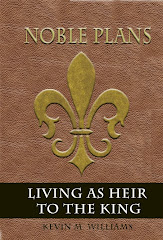
Noble Plans: Living as Heir to the King


Christians talk about being the “King’s kids” and title vacation Bible school programs by the same name. Believers wonder what it will be like reigning and ruling with the King of kings when the Messiah comes to His throne. Catholics and Protestants alike call our heavenly Father “King,” acknowledging at least in principle if not in practice, His boundless sovereignty. Yet why do so many miss the mark when it comes to living life in accord with our spiritual and scriptural
royal lineage?

I believe that there is within each and every person, both inside and out the community of the redeemed, a deep and residing passion for personal nobility; a nobleness mirrored in the One in whose image we were created. Every person on earth, as the Scriptures tell us, is created in the “image” of God—the Lord of the universe—and as such, we have implanted within our core the image of nobility, a resemblance of the Sovereign Creator. If the Almighty God, Supreme Ruler of the universe and King of all the earth is the image reflected in us, then by default, we have within our souls the potential for a most royal bearing.


"The noble man devises noble plans and by noble plans he stand"

Saturday, May 2, 2009

Protect & Defend Movie Week

This week on the Disney XD channel is called the "Protect & Defend Movie Week," with film greats such as The Lion, the Witch and the Wardrobe (2005), Eragon (2006), and The Incredibles (2004).

I enjoy all three films. They're filled with overcoming great odds, believing in something greater than yourself, and the most popular theme of all time – good versus evil. I don't think I'm alone in my appreciation. Millions upon millions of men, women, and children went to the cinema and bought DVD or digital copies.

Films are an important part of our pop culture, but they reveal a lot more. Each of these movies, for instance, is about simple folk reaching beyond themselves to discover a fantastically noble person inside. Each of these movies demonstrates moments of choosing to do the right thing despite the potential, personal loss. And each give the viewer an all around "good feeling" inside.

A couple of years ago, in a conversation with singer, songwriter, and author Michael Card, he told me that his mentor, Dr. William Lane believed that every Hollywood film has a messianic theme. Since that time with Michael, I've thought long and hard about that as I watch movies to conclude that he is right. Despite our cultural rejection of Christ and the Bible, there remains an avid hunger for a redeemer . . . and it shows in our blockbuster films.

Next time you go to the movies, as you munch on that popcorn and take in the silver screen, keep an eye open for that messianic character up there who saves the day, or makes the ultimate sacrifice. And when someone asks you what you thought of the movie, you'll have a new way to share your faith. Now that's a noble plan!


"The noble man devises noble plans and by noble plans he stand"