Today, as I see the adventures through the eyes of age and experience, I see the stories with new understanding. The epic battles are still engaging, but the parallels to mankind's modern dilemmas are ever-present. We think we have "evolved," but even after 1,500 years, we share much in common with the characters of Camelot.
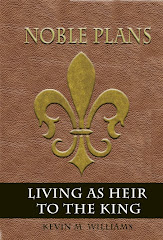
From the book Noble Plans:
It seems that in every generation, a new voice arises to this sense of nobility, or at least the desire to experience it. In the 1960’s, we had the Kennedy Whitehouse. Though I was a young boy at the time, the country seemed alive with a new sense of vigor and hope placed in the new “Camelot.” Yet as the years have gone by, all that glimmered was not gold. Decades later, the Kennedy administration is often remembered more for scandal and philandering than the noble ideals of Arthur’s Round Table. However, the dream of the Kennedy Camelot lives on unabated, revisited briefly in the 1990s during the Clinton Administration and hinted at again in the current Obama White House.Camelot is ingrained into our cultural consciousness. Her ideals are indefatigable. We all yearn for the Kingdom of Summer where right trumps might. But for too many, they are only ideals, a glimmering wish for our troubled times.
British Prime Minster Margaret Thatcher once said, “Unless we change our ways and our direction, our greatness as a nation will soon be a footnote in the history books, a distant memory of an offshore island, lost in the mists of time like Camelot, remembered kindly for its noble past.”
The Bible is far more succinct: "Pride goeth before the fall" (Pr 16:18). When might supersedes right, when justice is redefined to fit the situation rather than the rule of law, when morals are defined by politicians rather than the Supreme Authority, then we all risk being that "footnote in the history books."
The Bible points to a realm greater than Arthur's, a majesty far beyond Camelot: "Seek ye first the kingdom of God" (Mt 6:33). Evil found Camelot arrogant, and wrought ruin upon Arthur and the Golden City. Mankind has yearned for it ever since. But the Round Table was only a symbol, a shadow whose reality is cast by Christ and the Kingdom of Heaven, our true home and the answer to that deep yearning.
Behold, a king will reign righteously, And princes will rule justly.
And each will be like a refuge from the wind, And a shelter from the storm, Like streams of water in a dry country, Like the shade of a huge rock in a parched land.
Then the eyes of those who see will not be blinded, And the ears of those who hear will listen.
And the mind of the hasty will discern the truth, And the tongue of the stammerers will hasten to speak clearly.
No longer will the fool be called noble, Or the rogue be spoken of as generous.
For a fool speaks nonsense, And his heart inclines toward wickedness, To practice ungodliness and to speak error against the LORD, To keep the hungry person unsatisfied And to withhold drink from the thirsty.
As for a rogue, his weapons are evil; He devises wicked schemes To destroy the afflicted with slander, Even though the needy one speaks what is right.
But the noble man devises noble plans; And by noble plans he stands (Isaiah 32:1-8).
 |
"A noble man devises noble plans; and by noble plans he stands" (Isaiah 32:8)




 Posts

